

Monstera brings a piece of the jungle into your home

Monsteras have been among the most popular houseplants across generations. They reached the peak of their popularity especially during the socialist era, when you could see them in every hotel, restaurant and waiting room, often as very large plants reaching up to several meters. After that, however, interest in these plants faded. They have only come back into the spotlight in recent years, thanks to the great interest in houseplants in general and especially the wave of variegated varieties that until recently were practically impossible to get.
The name “monstera” alone suggests that this is no small plant. The best-known and most widespread species, Monstera deliciosa, known for its huge split and perforated leaves, can reach up to several meters, and its leaves can be more than 1 meter across, which may be why it has earned the nickname “queen of houseplants”. So keep in mind that if you want this plant at home, you will need to give it enough space.
Monstera is a genus of plants in the arum family, the “aroids”. They are mostly climbing vines with visible aerial roots and typically perforated and split leaves, but among monsteras you will also find species with classic leaves without holes. There are more than 40 species, and in the wild they grow mainly in humid tropical regions and rainforests from Mexico to Brazil and in the mountain rainforests of Central America. You would find them as hemiepiphytes on tree trunks, which they climb upward, while their long aerial roots draw nutrients and water from the surrounding moisture. Among monsteras, you will also find rare variegated species, which we wrote about in a previous article.
A (slightly) toxic houseplant
Like other “aroids”, all monsteras are toxic. They contain calcium oxalate, which can cause painful irritation of the mucous membranes and digestive tract when chewed. It can also cause swelling, a burning sensation, hoarseness and difficulty swallowing, but it is not fatal. If ingested, it can cause vomiting, drooling and stomach cramps. So keep an eye on small children in case they feel the urge to chew a leaf within reach, and on pets as well.
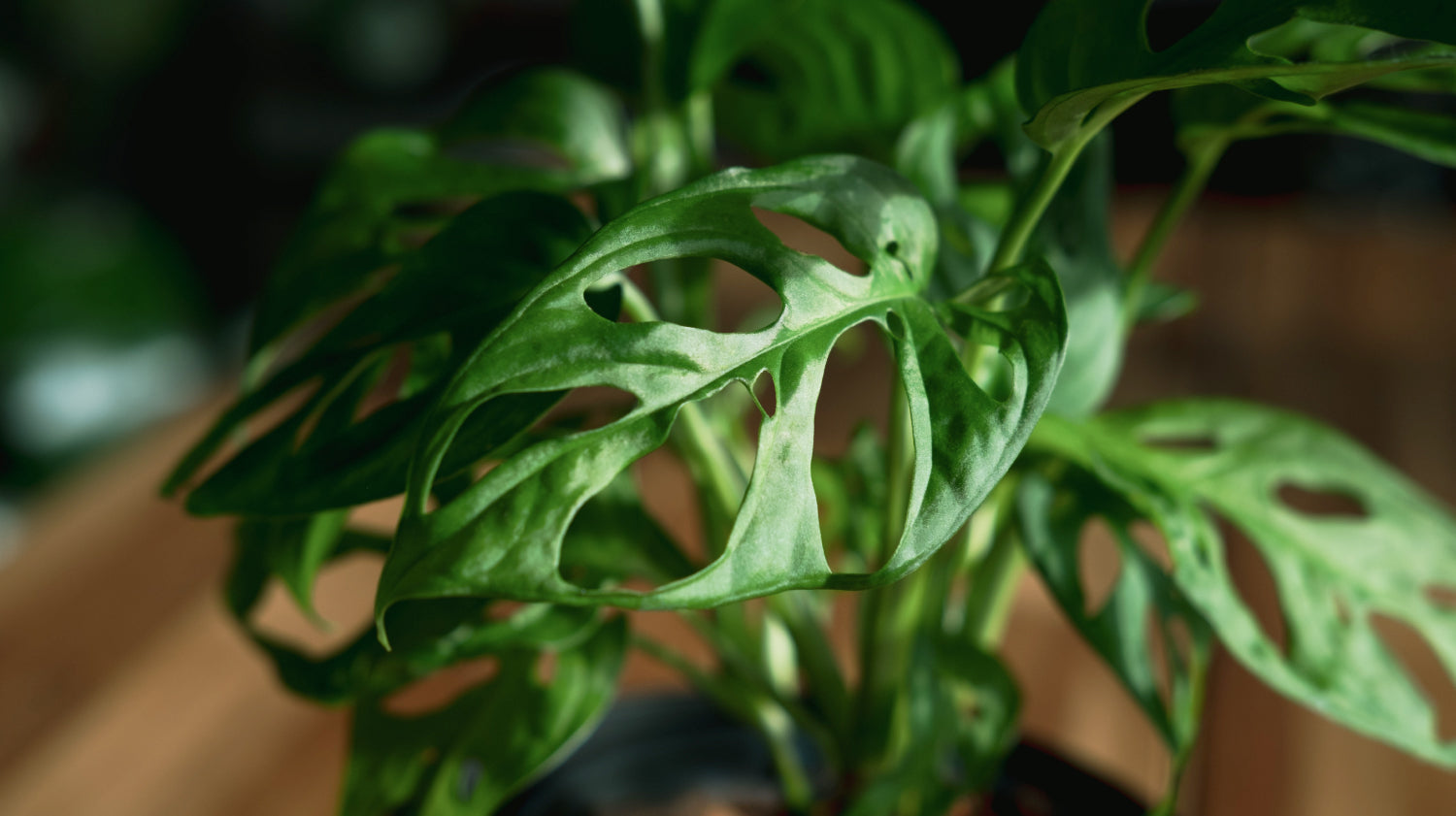
Photo: Monstera adansonii
How to care for monsteras so they grow beautifully
Monsteras will not put you off with any demanding care; pretty much anyone can manage it. Still, just as every plant has its needs, monsteras also need a few rules to be followed so that their growth is not just average but great. All monstera species need a support to grow well. You can use coir poles or, for smaller species, a sphagnum moss pole. Smaller species that trail nicely (such as Monstera adansonii, Monstera siltepecana, Monstera Standleyana...) can also be left to hang freely. With monsteras, it is also recommended to wipe the leaves with a soft damp cloth from time to time to remove dust, so the plant can breathe and absorb light better. You can use either a soft damp cloth or, for example, Forestina leaf wipes made especially for plants.
Light conditions
Monsteras prefer indirect light and can also cope with partial shade. If you want to grow the plant on a windowsill, the best choice is a west- or east-facing window, or a north-facing one if there is enough light.
When there is not enough light, its leaves may not form properly and the plant will not grow well. Not only may the monstera’s leaves be less deeply split, they may also get smaller and become irregularly deformed. Monstera is not one of the plants that tolerate full sun; its leaves could scorch.

Photo: wiping dust off monstera leaves
Watering
Be careful with watering: although monsteras love higher humidity and misting, people often confuse this with waterlogged soil. So, chronic overwaterers, take note. Do not overwater. Monsteras like a constantly moist potting mix, and you should let the top layer of the potting mix dry out before the next watering. Be sure to water less in the winter months.
If overwatered, the roots could start to rot, the leaves will turn yellow and the plant will quickly decline. With long-term overwatering, you can even kill the plant, and then only radical pruning and repotting will help the roots recover.
“With many monsteras, especially the larger ones, you will do best to water at regular intervals, for example once a week with the same amount of water, and work out how long it takes in your environment for the potting mix to ‘dry out’ before it needs watering again. Usually it is then enough to water, say, every Monday, come what may.”
Martin
Air and temperature
It is a tropical plant, so it thrives best in spaces with higher humidity. It will certainly do better in cooler hallways, for example, than in an overheated apartment in a concrete panel building or near a radiator. That is no obstacle, though; you just need to find the most suitable spot, whether in an apartment or a house. If you keep your monstera somewhere that is not very humid, you can help it by misting the leaves regularly, but that is only a stopgap. A home humidifier can also help, as it will noticeably raise the humidity in the room.
When humidity is too low, the leaves may dry out from the edges, and overall the leaves may not look very healthy.
“A little tip. Do you know how to tell that your plant is happy with the humidity? When more of its aerial roots start appearing and they start to grow longer. If a plant has short aerial roots for a long time, it usually means a drier environment that does not push the plant to send them out to catch moisture from the air.”
Martin

Photo: aerial roots wrapping around a coir pole
Suitable potting mix
Monsteras thrive in an airier, humus-rich potting mix that drains water well. The potting mix we recommend is the ready-mixed aroid potting mix, in which plants like the monstera do well; it is a blend of soil, perlite and coconut chips. The mix is well aerated, and aroid plants thrive in it. And if you would rather keep things simple, you can use ordinary houseplant potting mix with some perlite to aerate the soil, mixed for example with coconut chips or without them, and make a drainage layer at the bottom of the planter, for example from expanded clay (LECA). If you overwater, the water will partly drain through the soil to the bottom and the roots will not rot. The roots also breathe better overall.
Repotting and propagation
Monsteras, like all aroid houseplants, are very easy to propagate. All monstera species form so-called aerial roots at every leaf, which means you can simply propagate the plant by taking a cutting with an aerial root and 2 to 3 leaves, and over time new leaves will start to sprout from it. Then just leave the cutting in clean water for a while until it grows new roots from the aerial roots, or you can place it in moist sphagnum moss, which is made especially for faster rooting of plants. It is important that the aerial roots are submerged in water or sphagnum moss, because it is exactly from them that the plant will root.
We repot monsteras only when the root system fills the whole planter. This is usually about once every 2 years. For smaller and compact species, it may be sooner; it also depends on the conditions. We recommend repotting mainly in spring (March to April), when the plant starts growing more, and on that occasion you can also give it fresh potting mix full of nutrients.

Photo: a Monstera deliciosa flower bud in the wild
And what about the flower?
Of course, the monstera is not a flowering houseplant, but it does flower after all :) Just like alocasias and ZZ plants, the monstera can produce a spathe flower, which in the case of monsteras is even edible. However, it is a good idea to read up on eating it and on how the flower can be used.
The most common monsteras in our homes
As mentioned at the beginning, the number one spot goes to Monstera deliciosa, which almost everyone knows. Its smaller cousin Rhaphidophora tetrasperma, known as Monstera minima, is worth a look. It is a smaller plant and better suited to more compact trailing displays or smaller apartments. It is also an unusual and interesting choice for making a kokedama (moss ball)
A great favorite, also smaller in size and leaves, is Monstera adansonii, better known as Monstera Monkey mask, which in Czech is simply called “the little monkey”. It, too, is an interesting choice for a kokedama. Its not-too-distant sibling is Monstera Obliqua, a species that is very often mistaken for adansonii, because at first glance it can look the same. Unfortunately, it is a rarer species that is very hard to get here, and the difference between the two is that Monstera Obliqua, unlike adansonii, has even more perforated leaves, and its leaves are almost as thin as paper.
A very interesting collector’s plant is Monstera Dubia. At first glance, this species may resemble pothos plants such as Scindapsus. Nevertheless, it is a monstera, and a keen climber. It needs a support to grow, which is why it is usually sold on a wooden plank that it literally clings to.
Other available monsteras that, for a change, do not have split leaves include Monstera Karstenianum, which has slightly scalloped leaves shaped more like a thick arrow. A lesser-known species that is not so common here is Monstera Siltepecana, which also has unsplit, smaller leaves and, like pothos, can form a very dense trailing curtain over time. Last but not least, there is Monstera Standleyana, one of the variegated species, formerly known as Philodendron cobra, but today officially classified as a monstera. It has very dark green, narrow leaves with white variegation and looks very interesting in hanging planters or on supports.

Photo: Monstera Thai Constellation
And speaking of variegated species, the best-known and also the most popular one is without a doubt Monstera Albo deliciosa. Its look is unique, and its care may differ from that of ordinary monsteras in some respects. If you get one, we recommend reading up on the rules for variegated plants first. Fewer people know the second variegated monstera, but monstera lovers will surely know that it is Monstera Thai Constellation, which is a great rarity among monsteras and also one of the most expensive plants today. Some sellers may charge almost CZK 20,000 for it. Awareness of Monstera adansonii variegata has also been spreading a lot recently; it, too, is one of the very expensive and very hard-to-find species.
A piece of the jungle for everyone
Monsteras are without doubt interesting: some people fall in love with them, others cannot stand them. The fact is, though, that almost all species create a tropical rainforest atmosphere at first glance and suit almost any home. Anyone who has a monstera at home feels as if they were, at least a little, in the jungle :)
Do you have a question about monsteras? Not sure how to grow them? Do you feel you are doing everything right and your monstera is still struggling? Use our plant support service: message us via online chat or on social media.
Author: Martin Seidl