

Variegated houseplants

Everything you need to know about variegation
It is no secret that plants contain the pigment chlorophyll, which not only gives them their green color, but also lets them draw energy for their growth and existence through photosynthesis. There are quite a few pigments in the plant kingdom, but one of the most popular is white, the so-called variegation. And this article is all about variegation and variegated plants.
Variegation
In both the plant and animal kingdoms, variegation is a deviation from the usual coloring. Variegation refers to parts of plants that lose their usual green color, which is replaced by pale white or yellowish to yellow shades. The light coloring is the result of a decrease in, or complete absence of, chlorophyll, the green pigment. Besides attractive and unusual coloring, this also brings a few specific “problems” that variegated plants often struggle with. Before we look at the specific effects of white variegation, though, let’s explore a bit of the history and theory around it…
Causes and types of variegation
Variegation can be caused by a genetic disorder (gene mutation) or a virus, physiological damage to the plant, or artificial genetic modification. Variegated plants can occur commonly in nature, with variegation caused by natural development or by a genetic disorder and mutation. Because of how attractive the unusual look is, however, variegation has also been successfully induced artificially, in the laboratory. What is the difference between them?
Natural variegation
This is variegation that arises naturally. It can be a gene mutation that appears in a plant “by chance” or even on purpose. When it happens by chance, variegation is seen as a “disease” that can harm the plant’s viability (less chlorophyll can mean less energy for survival). But white coloring can also give plants certain advantages: thanks to their variegation, some plants are pollinated more often, in some cases even in the dark. Plants can also use variegation and various pigment patterns as protection or camouflage against animals. But watch out, a rule of nature may also apply here: everything that is different or colorful is poisonous and unfit to eat.
Fun fact: if the word variegata is the second word of a plant’s Latin name, it should refer to naturally occurring variegation, meaning the plant acquired its variegation in the wild.
Artificial variegation
This variegation came about through outside intervention, for example by humans, in the case of houseplants mainly to make them more attractive. Several methods are used, from crossbreeding to chemically inducing the coloring. The method chosen can then determine how extensive the induced variegation is and how long it “lasts”.

Photo: A leaf of a variegated Monstera Albo Variegata
Variegated plants
We now know that variegation is unusual plant coloring that can arise either naturally or artificially. In the wild, however, there are species in which it is completely normal, as well as species in which it is a rare deviation. Which of these two groups a plant belongs to also determines the different prices on the market.
If you are even a little interested in the world of houseplants, you have surely come across very popular variegated plants such as Monstera Albo Variegata and Monstera Thai Constellation (a rarer variety with cream coloring). The former definitely counts as a rare houseplant, but it is still more affordable than the even rarer “Thai”. The latest hit is the variegated Monstera Monkey Mask.
Other popular albinos include philodendron species (Philodendron White Princess, the more common one, or the rarer Philodendron White Knight or Wizard), as well as Syngonium Albo Variegata and all kinds of hoyas (wax plants).
But other plants are variegated too, and you can find them in our online store. Our favorites include Ficus Tineke and Triangularis Variegata, the variegated string of hearts, hibiscus and the variegated peace lily.
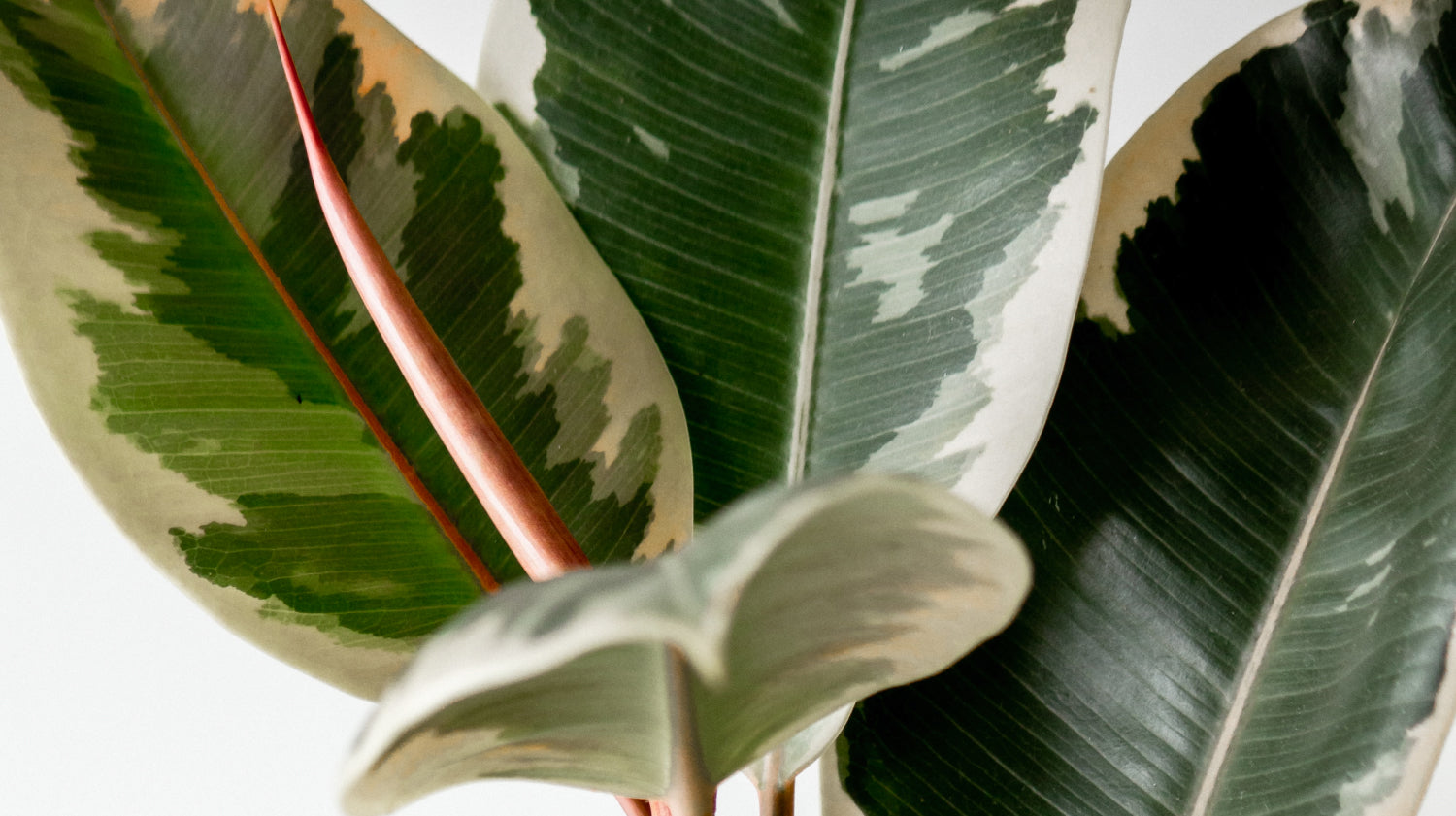
Photo: Ficus Tineke
Special care and “problems” with variegated plants
Because variegation goes hand in hand with less chlorophyll, variegated plants can be more demanding than classic green ones. That does not mean they need extreme care, though: that is more likely with collector’s items and rarities, such as the Monstera Monkey Mask Variegata mentioned earlier.
Plants, just like us humans, are all different: some can be more susceptible and sensitive, others very hardy, regardless of their coloring. When it comes to variegation, however, the rule is that if you want a beautiful plant with the strongest possible variegation, you need to look after its variegation.
Light
In general, we can say that a plant’s variegation is more likely to stay strong if the plant gets enough light. We can explain this by the fact that the more light a plant gets, the more likely its limited amount of chlorophyll is to produce enough energy. In the shade there is less sun, and so less energy is produced. That is why variegation fades and weakens when there is not enough light. In winter, when daylight naturally decreases, we can replace the natural source with special light bulbs.
Watch out: on the other hand, we need to be careful with direct light, which could quickly burn the white parts and leave unwanted, unsightly brown spots on them. Many growers make the major mistake of putting such a plant in full sun, and the plant quickly dies. If you want to give such plants some sun without killing them, consider northwest- to north-facing windows instead, where the sun is weakest and will shine on the plant for about 2 to 3 hours.
Watering
Variegated plants are also particular about correct, balanced watering. Because of their lower chlorophyll content (and lower energy intake), these plants usually grow more slowly and therefore also absorb water slowly. So they will probably need a different watering frequency and amount than other green plants.
Watch out: variegated plants are easy to overwater or, on the contrary, to let dry out, and both damage the leaves and therefore the whole plant. When it comes to watering, we also need to be careful with fertilizer: overfertilizing can also leave the leaves damaged.
Humidity
Variegation generally needs higher humidity so that the white parts without chlorophyll stay alive as long as possible. So it is a good idea to grow these plants (especially the rarer ones) in a greenhouse, for example, where we can give them both humidity and warmth, or to get a home humidifier.
Watch out: misting is not a good way to raise humidity for variegated plants. This is because the droplets we spray on a leaf can leave brown spots on the white parts of the leaves. Rather than misting, we can wipe the leaves with a damp cloth, but the greenhouse we mentioned, with its higher humidity, works best.

Photo: The typical problem of brown spots and a dying leaf.
And now the most common problems…
Variegation is a pigment deviation that unfortunately brings certain specific problems, which are not talked about as much. So what is good to keep in mind, and what should you mentally prepare for in advance when bringing home variegated beauties?
Browning and drying leaves: we have already mentioned the recommended care that variegation needs. However, browning and drying of the leaves, especially the variegated parts, is unfortunately also part of the natural life cycle of variegated plants. What does that mean?
We have said several times that variegation is caused by a lack of chlorophyll. Because of this, the plant takes in less energy. Over time, it is natural for plants to shed parts that weaken them, for the sake of their own survival. So the white parts may naturally die off in favor of the plant’s further growth.
“But that is the real magic of variegated plants: it is actually a miracle that you need to savor properly before it passes. Some plants can be beautifully variegated for a long time, others only for a while. In this way, they can remind us of the natural cycle of life and, at the same time, teach us to enjoy the present moment.”
Reverting, “Half-moon” and “Ghost” sensations: these are extreme phenomena related to variegation. The first can be an instant disappointment, the last a delayed one. So what does it mean when a plant reverts, forms a “half-moon” or becomes a “ghost”?
Reverting
In a way, this is also a natural phenomenon in which the plant gradually “gets rid of” its variegation, meaning the variegation disappears. It can happen with any coloring, and white is no exception.
We can delay reverting by giving variegated plants suitable care, above all by providing suitable light conditions. However, reverting can happen even with enough light. Every plant has genetics of different strength, and if the variegation genes are weak, the variegation may recede over time as the plant grows.
First aid: if you do not want to give up on your houseplant’s variegation without a fight, you can try cutting the plant back: remove the reverted part by taking a regular cutting (and grow a classic green variety of the houseplant, which may surprise you again in time) and hope that the variegation will appear with the new growth.

Photo: Typical half-moon variegation on a Syngonium Albo Variegata
Half-moon
This is a very attractive type of variegation in which the plant’s leaf is exactly half white (or otherwise pigmented) and half green. It really is an interesting sight, but in terms of genetics and the future of the variegation, it is a borderline state: further growth may be reverted, variegated in different ways again, or turn into the “Ghost” variant.
Watch out: because the future of “Half-moon” variegation is uncertain, it is wise to be careful when taking cuttings and propagating plants from the “Half-moon” part. Why? It is simple. If we have a “Half-moon” cutting where half of the stem and leaf is white and the other half green, the new growing point may appear on either half or exactly in between. It is actually a bit of a lottery. Will a green, a variegated or a “Ghost” plant grow?
Ghost
So what is this ghost we keep mentioning? It refers to a part of the plant that is completely variegated, for example a new, completely white leaf. “That must be gorgeous,” you think, but watch out. It is not called a ghost for nothing.
Watch out: when a plant turns into a ghost, it actually means it has lost its chlorophyll, its source of energy. And unfortunately, that does not bode well at all. The survival time of such a plant drops rapidly. In addition, the white parts are more prone to gradual, natural dying off and, even in ideal conditions, will not last forever.
"Remember: the more variegation, the longer everything takes for the plant."
First aid: a “Ghost” can be very attractive, no doubt about it. But also dangerous. If we do not want to exhaust the plant too much with such an onslaught of white without chlorophyll, we can help it again by propagating it from a cutting. We can keep the white part for a while and admire it (or take some nice photos), then cut it off and wait to see whether the plant produces new growth with at least some green, viable part.
Beauty is pain, or good things come to those who wait
Since that was quite a lot, it is time for a short summary of what matters most:
- Variegated plants lack chlorophyll in their white parts, so these parts cannot photosynthesize and produce energy for the plant. Variegation can (but does not have to) weaken the plant.
- Because of the lack of chlorophyll, these plants need slightly more conscientious care to support and maintain the variegation.
- The lack of chlorophyll also means these plants take longer to root and grow, and root less easily, so the best propagation method is “air layering”, which reduces the risk of rot and of losing fresh cuttings.
- Because variegation is rare in some species, these species go up in price, but this usually also goes hand in hand with more demanding care.
- Variegation can naturally fade (revert) or, on the contrary, produce a so-called “Ghost”: completely white coloring.
Mgr. Jana Beránková